Review of Wood,Talc and Mr J by Chris Rose.

Wood,Talc, and MrJ by Chris Rose.

‘You weren’t supposed to be clever where I came from…’

Readers who are used to Walkers Crisps in portioned packets will find opening this unfamiliar shrink wrapped alternative challenging. I certainly did. The first taste is of something indefinable; salty and lime flavoured, with more than a hint of sea, of vinegar, of jellied eels and certainly bracing. This book takes a willingness to be persuaded, but becomes increasingly addictive, as you bite into separate scenes, and ride a great many buses in pursuit of Sheffield United, the possibility of ‘gear’ or a good dust up with Skin heads or Rockers, and those who fail to appreciate the finer distinctions in Motown and Soul. This is not a world I know anything about, yet something in the self-effacing and evocative staccato began to mesmerize. It got better and better, once the idiom lodged, and more compelling.

I am not sure I can analyse why, or even that I garnered half of what its sharp language referred to, for it is a new language, and describes a world as unfamiliar as Bangladesh, although it only asks me to travel as far as Sheffield, Ilkley, Barnsley, Skegness and environs. Names and words encircle. Well that’s not all: it asks me to take on trust Sheffield in the seventies, through the eyes ears and nostrils of Phillip, its narrator and interpreter of the author’s sardonic, nostalgic and dismissive memory. Into Phillip he pours his unstated affection for his home but like a shirt tail that should not escape but does. If a reader is tempted to sympathy, it quickly disappears.

I feel I begin to get a little closer to its hooking summons to travel with it: Phillip is disarmingly devil-may-care on the surface. He refuses any self indulgence; his affectionate love of Grom (his grandmother-Edith) is epitomized by his refusal not only to take the same bus with her to work, (in Hell’s Satanic Mill) but a different bus route entirely. Her habit of torturing him by eating pungent and unsavoury food with gusto (and without teeth) and in public is politely avoided without resentment on either side.

This family understands one another. They are diffident, tolerant, undemonstrative, and loyal, and the influence of Grom permeates, even when she is absent. His father’s moral rectitude about the obligations of work and discipline, however unrewarded (except in affording legitimacy to weekends letting rip) stem from Grom, almost everything retains integrity, below the surface of seeming chaos. Phillip is quintessentially English in his refusal to disclose more than is decent about his feelings, except about music and song titles for these are safe pegs on which to define himself. They were unfamiliar to me but that was unimportant in this rollicking ride through period, seaside arcades, scooter racing, police check points, imminent catastrophe dared to come out by jeering at it, and his friendship with Jed,JustAbout, Paul, Pete, Mick and Uncle James. His names are minimalist,(his girl friends loved and moving past and on) but as expressive of the time as they are of the character of Phillip, who takes all as it comes (and goes). As must the reader, for this is a ride through affectionate memory of those loved and lost and a world being unwrapped from its confines in maturity; from Batty with her purple hair and his brother Sam’s gradual growth, closely observed.

There is little of ‘story’ in any external sense unless a rite of passage from adolescent to adulthood is story, and for most of us writers until it is told, other stories cannot get top billing or full attention. But it is the poetic vernacular that springs the surprises; they allow dandelions to bloom between the paving stones, tossed over the shoulder prolifically and without stopping; those ‘wagged schooldays’, ‘Madame Shake ‘n’Vac’, ‘heart-splintering honesty’ and ‘prematurely ripened humbug’. This is an extraordinarily original writer seemingly with an endless ability to dislocate the image until the cartilage gleams in the joints of small agonies. Because Phillip pities himself not at all, you feel for him and want to steady him with a hand before he trips on his shoelaces or cuts his feet. Poor Phillip. He will remain with you long after the book is closed. Open it and stay with it, for it is rich, and new. Then read it a second time.
Flowing forward: Looking back. (Blog cascade)

Flowing forward: Looking back. (Blog cascade). Introducing other writers and their reasons and methods.

Friends to Meet Friends?

Dear friends (37). Could I invite you to meet others lurking elsewhere.? Will you stay with this site move…think of it as a holiday home? ( Right now we are sitting in the shade of the Marrakesh Market) where  my book has taken over proceedings and is telling stories. Soon we will move to Africa. Please stay friends and register as such on the book’s site. That way my modest blogs will find you and I will be able to talk to you and give you things, mostly ideas.

The Book that Wrote the Life.

I am relieved of duties and the book is taking over, offering small components it  fed into my life to ensure its production. I never knew till now that it had commandeered my entire journey. There is a warning for all of you here, watch out for your book behind the door, it is quite ruthless. Even your convivial friends for supper will feed its appetite. It is always listening in!

CELEBRATION. New reviews from very kind readers have been posted on Amazon’s book page and when you visit my blog over there, you may want to link, but I’d rather just talk direct for now. Really grateful if you’ll come.

Introducing Careless Talk (Costs Lives?)

CARELESS TALK (Costs Lives)

This blog will link to my other post where ideas implicit in the book ‘Involution-An Odyssey’. are played about with. There are many and they spread into everything. The Philosophy of Self-importance, that where I reflect. (Others more impulsive will be posted here)

It is about the world of logos, and the lives that give them breath. Reasons to record. Not the market, nor the stratagems, for I have no knowledge of that kind to offer.

It’s central observation is that lives are shaped by the ideas that also give rise to the books; books are the debris left by life. If we have something to say it is only because we recognise our uniqueness, and the extraordinary. Not the ordinary. So I will begin by being candid. My lives ( more like a cat ) have been improbable, but I suspect any reader of this blog would say the same. So here is a place to say it. How has your life shaped your book(s) and why was it so important to write it? I will happily host posts that are relevant to this idea because those will touch us all at some ganglion of connection. Making sense of life, be it in universal story (your twist? Your exposure? Your solution? And your hopes?) or your wisdom ( How derived? Why necessary? How provoked? What solved?). So both fiction and non fiction for they are both imagination. We’ll come to that anon.

The Naming of Parts

The Naming of Parts

Last Friday I promised to introduce some characters (and I will) but something intervened which seemed a worthwhile detour; the question of names. What intervened was reading a guest blog from Linda Gillard on Roz Morris’s ‘Undercover Soundtrack’ (my unvarying Wednesday habit of the week). In amongst all the music featured by other writers this one was inspired by Philip Glass.

I realised that my belief that I disliked of the music of Philip Glass probably stemmed entirely from his name. Brittle, transparent, unyielding, surface, glitter, glass harmonica, self reflective, sharp, wintry, the voice that shatters…. All come to the mind in that small single word (even though we share a Christian name it does not ameliorate the power of ‘glass’.) I realised I hardly knew the music of Philip Glass and that was the likely reason. John Cage was not much better: imprisoned, restricted, stale, cruel, limed, in need of cleaning. Perhaps it is a poet’s mind, with unending echoes of association. We weave webs from words and find ourselves caught by them. Now that I have really listened to the Glass violin concerto as related and focussed by another’s response to it, I found it incredibly poignant and mesmerising.

So prejudice kept a mind closed.

How relevant might this be to the naming of character parts? How acute an attention ought we to give it?

Did anyone see ‘Enchanted April’ and resonate with Mrs Wilkins saying she hated ‘Wilkins’ with its ‘kins’, its diminutive piggy tail? I so did!

I have always liked my name, Philippa, (Philos, Hippos…a lover of horses) and wonder whether my absorption with horses all my life was caused by it? Of did my mother have prescience? It was very uncommon back then. I only ever met one other. If so, she did not know how many would massacre its ancient Greek beauty by spelling it incorrectly. How many people spell Philosopher with two ‘Ls’? Yet I could never give a character an over familiar name, it would imprison any freedom they might need, and once envisioned characters take on their own life.

The rushing power of names and the harness of them are, for me, almost un-brookable. Does any one else feel this way? When I read a book in which a place name is contrived, unlikely to be in the County in which it is set I immediately distrust the writer’s sensitivity to history or place. J.K. Rowling, a genius with names in Harry Potter, now chooses ‘Pagford’ (slag, hag, tinker, all overwhelm the ‘ford’) for a ‘pretty village’ It does not quite ring true and certainly does not (for me) convey a ‘pretty village’. Too plausible however (like ‘Midsomer’ Murders), becomes merely dull. How to strike the balance between what you as author ‘feel’ in the name and what your readers’ references to it may be? It may be quite the opposite of what we expect.

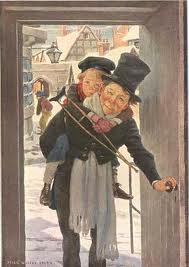
One of the reasons I love Trollope is because his names are creatively uncompromising, nothing is left unstated: Obadiah Slope is both revengeful Old Testament and yet slippery as an eel, his hypocrisy and self importance all in the name. Mrs Proudie all chins and heaving indignation. Dickens’s Bob Cratchit, scratches on his high stool forever. We can then get on to the nuances of their situation. One could not get away with it now …although I did once try with ‘Geoffrey Mentwell’ ( a benevolent but bumbling retired schoolmaster- managing always to step in it) in a rural TV comedy.

A Christmas Carol
Bent with Service
Conceit personified

I feel that names carry with them all the qualities of those who gave them life before. So much so that naming my daughters was an exercise in bequeathing them conscious associations, hoping their lives would be shaped by their names…all Shakespearean (I wanted them deep-rooted) but with modulated second names to correct extremes. ‘Juliet’ was destined to inspire passion, and retain delightful innocence but I did not want passion lethal so she needed ‘Emma’ (Woodhouse) to correct the balance. In a general way there is something in each that does resonate with their literary forbears. I still wonder how I allocated them and in the right order? Re-incarnation decided and I was just the mouthpiece?

I would be interested to hear the views of others on this, and how they arrive at the names for characters, and what goes into making their choices?

Last week I mentioned a character called Vernon. He is a major character in a novel and has a hot/cold platonic relationship with Claudia. Would anyone start the ball rolling by describing what those names convey to them? Before I flesh them out in interaction? Flash portraits would be great! It would be interesting to discover what degree of congruence there is, and whether the importance I give to it, is justified. I doubt it is a habit I could shed, whatever we might discover.