I have always loved Queen Elizabeth’s description of herself as ‘mere English’. Never was a character less mere! Since last week’s invitation to thumbnail a portrait from two names failed to bring any volunteer out of the shadows, or put down his/her pint for long enough, I have decided to reverse the process. If this poem evokes a person (and it did describe one, originally) why not give him/her a name? If not, I hope you just enjoy this very un-Elizabethan character, who could well find a place in Trollope or Austen, or Henry James, but would be un-noticed by George Eliot!
Mere English
You would not care for Africa, you say;
the narrowness of mind that travel brings…
No persuasion had you venture forth
from Dorset and her soft enclosing hills.
‘Why precipitate adventure when instead
monotony so benignly passes time?
Why think, when thought pricks restlessness
or worse, provokes an impulse to the day?’
The winds of soft-stirred longing which arose
were raiment of an English tempered muse.
Metered music and the symmetry of stone…
The dim glimmer of a chancel, summoning…
Were all the pulse allowed the dying risk of age.
No oceans all engraved with serpent coils…
Terror incognita, (I know it well…)
The map but not the diction: Heavens, names and foreign foods!
the spaces better blank to seed with certain platitudes.
Last Friday I promised to introduce some characters (and I will) but something intervened which seemed a worthwhile detour; the question of names. What intervened was reading a guest blog from Linda Gillard on Roz Morris’s ‘Undercover Soundtrack’ (my unvarying Wednesday habit of the week). In amongst all the music featured by other writers this one was inspired by Philip Glass.
I realised that my belief that I disliked of the music of Philip Glass probably stemmed entirely from his name. Brittle, transparent, unyielding, surface, glitter, glass harmonica, self reflective, sharp, wintry, the voice that shatters…. All come to the mind in that small single word (even though we share a Christian name it does not ameliorate the power of ‘glass’.) I realised I hardly knew the music of Philip Glass and that was the likely reason. John Cage was not much better: imprisoned, restricted, stale, cruel, limed, in need of cleaning. Perhaps it is a poet’s mind, with unending echoes of association. We weave webs from words and find ourselves caught by them. Now that I have really listened to the Glass violin concerto as related and focussed by another’s response to it, I found it incredibly poignant and mesmerising.
So prejudice kept a mind closed.
How relevant might this be to the naming of character parts? How acute an attention ought we to give it?
Did anyone see ‘Enchanted April’ and resonate with Mrs Wilkins saying she hated ‘Wilkins’ with its ‘kins’, its diminutive piggy tail? I so did!
I have always liked my name, Philippa, (Philos, Hippos…a lover of horses) and wonder whether my absorption with horses all my life was caused by it? Of did my mother have prescience? It was very uncommon back then. I only ever met one other. If so, she did not know how many would massacre its ancient Greek beauty by spelling it incorrectly. How many people spell Philosopher with two ‘Ls’? Yet I could never give a character an over familiar name, it would imprison any freedom they might need, and once envisioned characters take on their own life.
The rushing power of names and the harness of them are, for me, almost un-brookable. Does any one else feel this way? When I read a book in which a place name is contrived, unlikely to be in the County in which it is set I immediately distrust the writer’s sensitivity to history or place. J.K. Rowling, a genius with names in Harry Potter, now chooses ‘Pagford’ (slag, hag, tinker, all overwhelm the ‘ford’) for a ‘pretty village’ It does not quite ring true and certainly does not (for me) convey a ‘pretty village’. Too plausible however (like ‘Midsomer’ Murders), becomes merely dull. How to strike the balance between what you as author ‘feel’ in the name and what your readers’ references to it may be? It may be quite the opposite of what we expect.
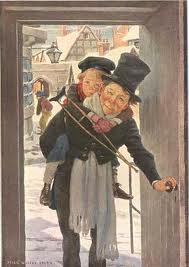
One of the reasons I love Trollope is because his names are creatively uncompromising, nothing is left unstated: Obadiah Slope is both revengeful Old Testament and yet slippery as an eel, his hypocrisy and self importance all in the name. Mrs Proudie all chins and heaving indignation. Dickens’s Bob Cratchit, scratches on his high stool forever. We can then get on to the nuances of their situation. One could not get away with it now …although I did once try with ‘Geoffrey Mentwell’ ( a benevolent but bumbling retired schoolmaster- managing always to step in it) in a rural TV comedy.
Bent with ServiceConceit personified
I feel that names carry with them all the qualities of those who gave them life before. So much so that naming my daughters was an exercise in bequeathing them conscious associations, hoping their lives would be shaped by their names…all Shakespearean (I wanted them deep-rooted) but with modulated second names to correct extremes. ‘Juliet’ was destined to inspire passion, and retain delightful innocence but I did not want passion lethal so she needed ‘Emma’ (Woodhouse) to correct the balance. In a general way there is something in each that does resonate with their literary forbears. I still wonder how I allocated them and in the right order? Re-incarnation decided and I was just the mouthpiece?
I would be interested to hear the views of others on this, and how they arrive at the names for characters, and what goes into making their choices?
Last week I mentioned a character called Vernon. He is a major character in a novel and has a hot/cold platonic relationship with Claudia. Would anyone start the ball rolling by describing what those names convey to them? Before I flesh them out in interaction? Flash portraits would be great! It would be interesting to discover what degree of congruence there is, and whether the importance I give to it, is justified. I doubt it is a habit I could shed, whatever we might discover.
I have now taken on board the received wisdom that suggests that blogging, like writing must FOCUS. Of all the wares we might display we must choose the brightest shiniest, most needed. If that was not enough, we should put a box of free offers where the passer by cannot but trip over it, and human nature, being acquisitive, will undoubtedly buy one to get one free.
BUT, and this is important, one must stay well hidden beneath the potatoes, or behind the fly screen, emerging or raising a reluctant head to admit we might be willing to sell but only ‘ if you’re really really sure?’
I would challenge any passer by (and they are few and far between) what, reading my latest attempt to focus— which is my bright and shiny new tag line— I might be willing or able to offer? What d’ya reckon philosophy is worth? Poetry is a dime-a-dozen, and synchronicity depends upon…well… unforeseen forces. Unmistakeable when it happens but it happens unpredictably. I can’t count on it to oblige once a week.
The ‘World of Ideas’ is an AliBaba cave of possibilities but hardly focussed! ( But because I cannot resist a challenge I have started with a real big one…the truth and relevance of the Mayan Long Count Calendar…see Paul Drewfs incredible book reviewed here:)
When I write a novel (and I have…three…none published) the greatest comfort is when the characters take matters into their own hands. They tell me, with pursed lips and schoolmarm glaring, what they would say and to whom. They take it into their heads to buy a puppy I never expected to clean up after; they meet eccentrics who editors say are ‘not plausible’, and have themselves a time, at my expense.
As I am constitutionally incapable of telling anybody how to live their lives, why would I start with my characters? They are the most interesting people I know. Now I have the germ of an idea…
On Fridays…yes since this is a Friday and blogs, I gather, must be as regular as you-know-what… I will introduce some of them. They are much more fun than I am. Feel free to argue with them or invite them for a walk or a night on the town. I’ll just listen. Once a reader wrote to tell me (long after finishing a book) that he missed Vernon terribly…felt bereft without his best friend…no-one to drink with. That was a high point
Maybe I don’t need a publisher. Are you sitting comfortably? Next week I’ll begin…
I shall surface like the mermaid seal, untouchable…
This is an extract from the poetic evocation of the sixties ‘A Shadow in Yucatan’ which is set in Florida. (A review can be found under ‘Books’) Posting this today is a celebration of a memory offered by Erica Robuck’s Undercover Soundtrack on http://mymemoriesofafuturelife.com
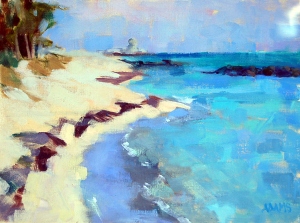
The painting is offered with the kind permission of the artist Trisha Adams whose studio can/ no, should be visited for a taste of sunlight.
Sunday- Key West.
I shall go hang on the Continent’s tail, beyond the Barfly at Sloppy Joe’s Heedless of his beard and belching, my oaths will be toes
in the aimless water…Nostrils to the brindled air. Space will shimmer scents from Tenochtitlan. Gold bracelets bind me to the suicide of Cortez. I am lost, but I shall find. They will never follow me.
I shall tread juice from tobacco clippings, and watch the old men spit. Havana ola, in the speckled shadows of the straw market, my feet in the ashes, my cheeks smeared with clay, wanton, outcast like them. I shall not lick or roll. I shall not have to work I shall simply be there. For a day.
I shall eat smoked mackerel, pungent with wood,
steamed by the water, in a tipping boat. The heaving horizon I shall tame to undulation. I have spoken. I shall swim. I shall tip boat-barrel and glide among the hawsers of
forgotten hulks, black amid keels, menacing with mouths. Treasure is forgetfulness. I shall sink.
I shall surface like the mermaid seal, untouchable. Drag my gleaming limb. Lollop and skid on the board-walk to watch the taffeta water
summon the world to drink. I shall squint through rust and bitumen. Bite through my lip.
The surgeon sun will fit me legs, brace my back and bandage my eyes. I will be led to convalesce. The gold gulf wind will draw me unobserved past shutters, rocking chairs and limes.
The machismo of yesterday is a hat by the water’s edge.
Boat, below the saddle of hill, rides the sway-back hummock grass
Moored against the end of the lane; tilts a chin to the drifting cloud,
Blows smoke kisses to the wind and rain; hails all elements as friends
None entering or passing by need wipe off feet or hands.
The door in permanent spasm can neither close nor stay ajar.
Bless-me sun has a needle stuck on a gap-tooth grin of spring
Shadows that have shed their shoes pull at bramble and wild colt,
Bulging tool-shed tethered with chain on the off-chance it might bolt.
Two gumboots, silent gaffers, relax on the broken step
Ignored by planters, iron pots, overflowing matted grass…
Closing their sun-blinded eyes; chew at smothered bulb…
The old boat rocks at anchor strain, its song a creaking hull.
Kneaded by fingers of babbling babes; kicked by bruising boys,
Stage for smashing arguments; quiet nights of mutual bliss…
Wringing out cold compress to bleeding black-eyed divorce;
Serene it coasts vicissitude; gives two masts to local reproach.
……………………
Beyond the marina of teak-oil stone; exiled by the well-heeled wharf,
The flotilla of circling circumspect homes; each with a view of the green,
Sailing across the well clipped grass where shaggy goats were tethered…
The Common much less common since corduroy Colonels moved in.
Beyond the watch at double door the Labrador flicks a frown
To passing ladders, green eyed cat; the Thatcher with next season’s quote,
Pop-in friend with lists and flowers…
The trial of the fancy-dress demand of the children’s annual fete…
……….
A narrow jetty stretches into the hill to the quarantined boat, patently ill;
Moored out of sight; buckled by hedge, swift sluicing course…
Peeling skin in scrofulous flakes onto cracked and rising flags,
Rusting pails and harness for the broken-winded horse.
An isolated case of trust in a simple right to decline
In company with the Captain who is eighty (if a day)
She’s the tiller on her children’s lives, the tea-caddy of their coin;
She wears a waxed all-weather cape below a sharp white crown…
She doesn’t stop to give a damn, nor does Sparky her clown.
The Woman-who-thought-she-could-write
realised (with her morning tea), on March eighth,
that she had been misled.
She looked at Language snoring beside her,
his lascivious tongue flickering kisses…
and wondered what she’d ever seen in him.
In the early days he was lithe and spare:
Lean as a leaf that could cut a thumb;
moist as an eye in a crucifixion.
The traps he sprung watered cheeks with pearls…
Laughter bubbled unforced.
His seduction had shaved pencils;
spearing dark dreams like bats fleeing light.
Now he sulked, demanded home cooking…
Cracking bones, complaining…
at a desk-top boiling all day.
How had insinuation slithered
(Persuading the Word to ape God?)
between the smooth sheets of a welcome.
The coral brained dish of endeavour
turning black with nicotine.
The Egyptians were content with an alphabet;
awaiting Napoleon, planning parchment or paper?
It was no big deal, sand would suffice.
Millennia passed…
chipping stone, slurping beer.
Talk alone managed to trade and to travel…
The river flooded without self-assembly instructions…
Pyramids made their point, and were proved non-combustible.
Who is Posterity?
What is the fuss?
Her garlanded Bacchus had grown obese
snorting lines of attention;
sweating metaphors sweet,
astride his tortoise, bibulous, self-serving,
as flaccid as the spittle sliding
down
his
chin.
The galleon of grandmamma billowed through doorways leaving no wind but the scent of cologne. Her horn-handled stick communed with the floor like the serpent with Eve, both bent upon a domestic secret service.
The boiler house alive; steam and invective, stammering lids, riddled coals…wither the larder sent knaves to forlorn persecution; speared with clove, smeared with brown sugar, basted under prodding inquisition…
The flaying of oranges, the shelling of nuts… (Hourly conscripts, the aproned maids gossiping in the sun on the stoep of escape). The trussing of fowl, the knotting of pressed tongue gilded the hours of her kingdom kitchen.
Wafted seasonal juniper, caraway, mulling of wine… Sounding drums of enamel, the harp of shattered glass… Courtiers of dishes medalled in silver… Embroidered with parsley, tickling a piglet, its jaws impaled on original sin.
She presided in pearls, with sardonic self-mockery Smothered each dish with a sauce of jellied laughter… And her imperious injunction ‘So eat’
Was there ever a more appropriate name for the winner of this particular season’s Derby, but Camelot? Was there ever a boy more in tune with his mount? From the moment he was lifted to the saddle Joseph O’Brien quietly took command of the race before it had begun, directing Camelot to the far rails, away from distractions, like any keyed up athlete, needing calm concentration. Watching his controlled canter to the start, one knew this was a master at work, deeply sensitive to the moment, and the needs of his superlative horse. It reduced me to tears.
The romance of horse-racing lies in many things, the poetic pictures of Degas, the traditions of the colours, and the co-ordination of stable boys, grooms, trainers and jockeys, but ultimately it is the celebration of the horse. The superlative aristocracy and beauty of the animal, that challenges all our human sense of superiority, by something aesthetic, intelligent, alive and peerless is what holds mankind in thrall, and so it should. No greater tribute to the Queen’s greatest love will be given for all the razzmatazz. That race will live with me forever, and that boy’s gentle modesty.
I shall be leaving shortly, elbowed out by the bend in a year. While my full-tilt daughters that have learned to run still bloody their knees on the stones of men.
They dream dreams that resemble my own, forlorn in the nettles of credit, the dock of the bell… Dropping the tails of bright lizards that flick beneath the spines of seductive books.
My roses fell soft without cutting or choice… Four daughters were hardier wilder sports: Grafted on plans they draft divorce, with thyme for reading, lavenders of children (discarded by storks)
How old, how shrunken this wizened age that measures the girth of an unlived year. I try to forget the dimensions of births, untrammelled by visions opaque or clear.
Their passions are pruned; mine rampant yet the hour-glass trickles sterile thin sand. Their visions and mine no longer discern whose pillow they water; whose shoulder they turn.
Before my mouth is stopped with clay and cold ice glazes the lucid eye… Will dreams gush forth from the trickling throat and pith crack clean from the collar wish-bone?
SITE UNDER RECONSTRUCTION. NO HARD HATS AVAILABLE.
I’LL LAUNCH A PARTY WHEN ITS READY!
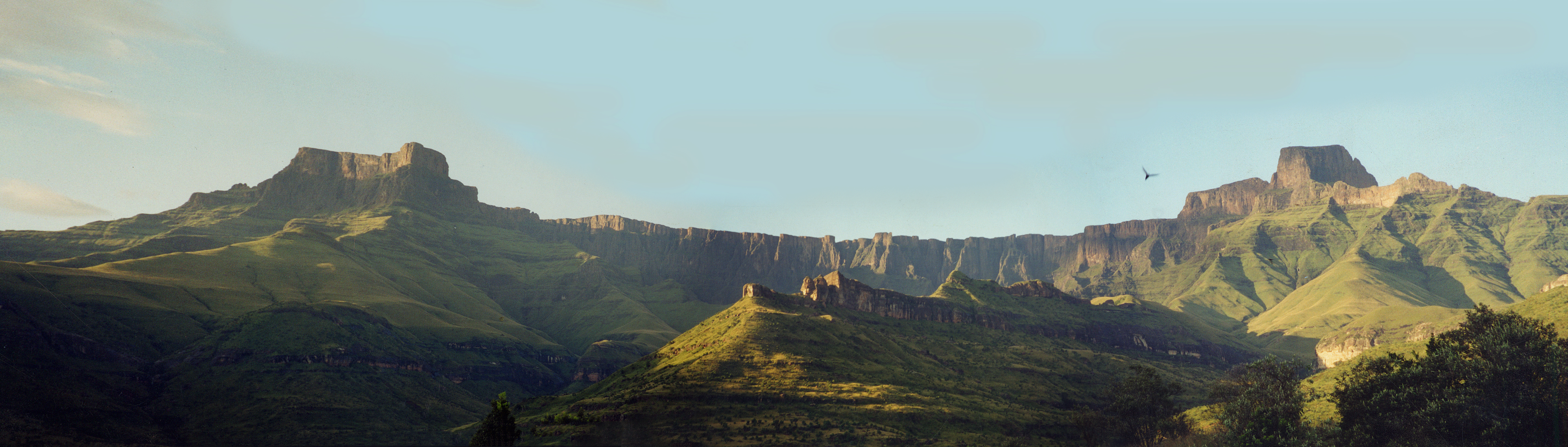
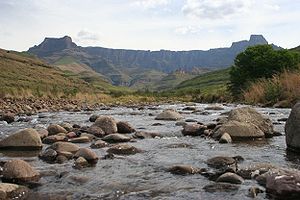
Many people have asked about the photograph in the Header. This was taken in early morning in 2000, and it is of the spectacular Amphitheatre in the northern Drakensberg not far from my family’s farm in the Freestate (where I was born). This cliff face is three times the size of all the cliff faces in the Yosemite Park, rising 10.000 feet above sea level and 4000 above the base. The buttress on the left is called the Mont aux Sources since it gives rise to many rivers, notably the Tugela, flowing east, but also via its tributary (The Caledon) to the Orange flowing west, and via the Elands to the Vaal flowing North. It stands sentinel as the very navel of the country and its arteries. The walk up the Tugela towards the summit is through narrow passes overshadowed by trees and calling monkeys, and ever the bubbling water…
As a child I rode through this country in my holidays with saddlebags, picnics and plunging in cold pools. Its call is everlasting, and gets stronger now I know I shall never see it again.
GNU Free Documentation Licence PhilipN Version 1.2







 PHI lippa. Letters of Love